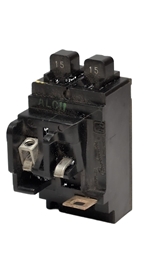
What ESP stocks
- P1 series — single pole, 120 volt: P115, P120, P130, P140 and P150, 15 to 50 amperes
- P2 series — two pole, 120/240 volt: P215, P220, P230, P240 and P250, 15 to 50 amperes
- P1515 and P2020 — tandem units
Every breaker is inspected, cleaned and tested to ESP Product Standards before it ships, and carries a one-year operational guarantee. Pushmatic units are tested for continuity, insulation resistance and trip operation, and the push mechanism is exercised to confirm free movement.
Common questions
Why do Pushmatic breakers have no toggle?
Pushmatic units switch by push button rather than a toggle handle, and the button does not change position to indicate a tripped state. The mechanism is sealed, which is why a tripped Pushmatic breaker can be difficult to identify by sight. Resetting requires pushing the button firmly to the off position and then back on.
Do Pushmatic breakers need to be exercised?
The push mechanism stiffens with age and disuse, and a breaker that has not been operated in years may require noticeably more force or may fail to trip at its rated current. Periodic operation is commonly recommended for mechanisms of this type. Testing whether a given breaker still trips correctly requires equipment a licensed electrician would have.
Are ITE and Bulldog Pushmatic breakers the same?
Bulldog developed the Pushmatic line and ITE acquired it, so breakers of the same catalog number appear under both labels and are generally interchangeable within a Pushmatic panel. The catalog number on the breaker face is what determines fit, not the brand name printed alongside it.